

If you’re considering the process of jump-starting vehicles, you may find yourself grappling with the question, “Is jump-starting a diesel different?”
We’re here to answer this question and detail the steps to follow to jump start a diesel vehicle.
Let’s get to it.
Jump starting a diesel engine is quite different from jump-starting a gasoline engine due to the differences in their ignition systems and the amount of power required to start the engines.
Here is why jump starting a diesel car is quite different from jump starting a gasoline/ petrol car:
1. Higher Voltage Requirements
Diesel engines generally require more voltage to start compared to gasoline engines. This is because they have significantly higher compression ratios. As a result, the portable jump starter used for a diesel engine should have a higher peak current rating to provide the necessary power to crank the engine. That’s why it’s important to consider a jump starter’s peak current rating to ensure you get the right device that provides reliable performance when it matters most.
2. Battery Capacity
Jump starting a diesel engine requires a higher battery capacity because diesel-powered engines tend to have larger and more robust batteries than gasoline engines. If you’re jump-starting a diesel vehicle with a low-capacity jump starter, it might not deliver enough power to start the diesel engine successfully. A portable jump starter with a higher battery capacity indicates more power and performance, making it suitable for larger vehicles and equipment.
3. Wait Time
Diesel engines usually have a longer glow plug warm-up time before starting. When jump-starting a diesel, you may need to wait a few extra seconds before attempting to start the engine to allow the glow plugs to heat up properly.
On the other hand, gasoline engines rely on spark plugs to ignite the air-fuel mixture. When you start a gasoline engine, the spark plugs generate an electric spark that ignites the compressed air-fuel mixture in the combustion chamber.
Since gasoline engines use spark plugs for ignition, there is no concept of glow plug warm-up time in gas-powered engines. Instead, gasoline engines may require a brief moment for the engine to prepare before starting. However, this process is generally much faster than the glow plug warm-up time in diesel engines.
4. Continuous Cranking
Diesel engines may require longer cranking periods during jump-starting compared to gasoline engines. This is because diesel engines rely on high compression and heat to ignite the fuel. As a result, they require more sustained cranking to achieve combustion.
While the basic principles of jump-starting remain the same for both gasoline and diesel engines, being aware of these differences can help you jump start your vehicle successfully.
Now that you understand how jump starting a diesel engine differs from gas-powered engines, let’s look at how to jump start a diesel vehicle.
How to Jump Start a Diesel Car: 9 Steps
Jump-starting a car using a portable jump starter is a straightforward process. Here’s a step-by-step guide on how to do it:
Step 1: Choose the Right Jump Starter
This may sound obvious, but it’s worth mentioning because many car owners buy the wrong jump starters and end up getting frustrated. Ensure your portable jump starter is suitable for jump-starting diesel engines. Look for a jump starter with a high peak current rating, capable of delivering the extra power needed by diesel engines.
If you’re overwhelmed with the choices available on the market, we recommend you opt for a NOCO Boost Max GB500+. This jump starter is suitable for jump starting a wide range of diesel-powered vehicles and equipment.
Step 2: Safety First
We can’t emphasize this enough. Before you get started, ensure both vehicles are in park or neutral with their ignition off. Be sure to engage the parking brakes, and wear safety gloves and eye protection. The last thing you want to experience is unintended vehicle movement when you’re jump starting your car or damaging your vehicle’s electrical components.
Step 3: Power Off the Jump Starter
Double-check that the portable jump starter is turned off to avoid any accidental sparks during connection.
Step 4: Identify Battery Terminals
Open the car hoods and identify the positive and negative battery terminals on both vehicles. The positive terminal is usually marked with a (+) sign and a red cover, while the negative terminal is marked with a (-) sign and a black cover.
Step 5: Connect the Cables
Take the red (positive) jumper cable and attach one end to the positive terminal of the dead battery. Then, connect the other end to the positive terminal of the portable jump starter. Next, take the black (negative) jumper cable and attach one end to the negative terminal of the portable jump starter. Lastly, connect the other end of the black cable to a metal, unpainted part of the vehicle.
Step 6: Power On the Jump Starter:
Now, power on the portable jump starter. Some models may have an “On/Off” switch or a power button.
Step 7: Start the Engine
Once the jump starter is on, turn the ignition key to start the engine. If it doesn’t start immediately, wait a few moments, and then try again. Once the engine starts, leave it running for a minute or two to allow the battery to recharge.
Step 8: Disconnect the Cables
With the engine running, carefully disconnect the jumper cables in reverse order. First, remove the black cable from the metal part of the vehicle, then remove it from the negative terminal of the portable jump starter. Next, remove the red cable from the positive terminal of the jump starter and then from the positive terminal of the previously dead battery.
Step 9: Recharge the Jump Starter
After you’ve successfully jump started your vehicle, remember to recharge the portable jump starter so it’s ready for the next emergency.
There you have it. These are the 9 steps to safely and effectively jump-start your car using a portable jump starter.
Looking For a Reliable Portable Jump Starter? Try The NOCO Boost Max GB500+
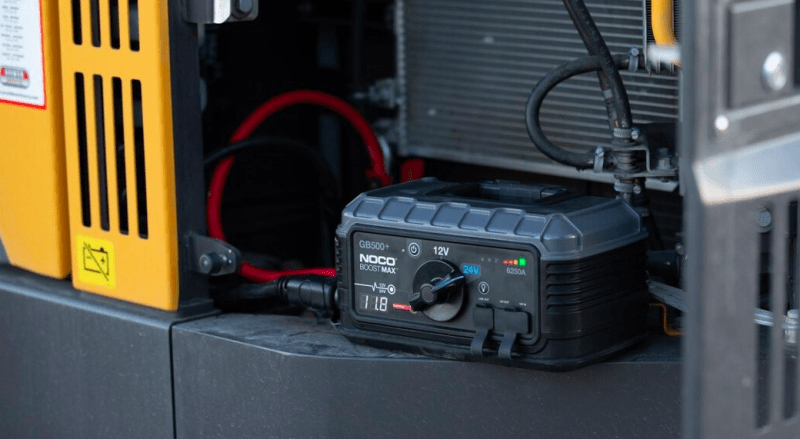
If you’re in the market for a portable jump starter for diesel engines, look no further than the NOCO Boost Max GB500+. With a whopping 6250-amps of starting power, the NOCO Boost Max GB500+ packs a punch to jump-start even the largest diesel engines effortlessly. It ensures a quick and reliable start every time, making it ideal for trucks, SUVs, and other heavy-duty vehicles. Here are the biggest NOCO jump starters.
Safety is paramount when jump starting your vehicle, and the NOCO Boost Max GB500+ excels in this aspect. Equipped with advanced safety features like reverse polarity protection and spark-proof technology, this battery pack shields both you and your vehicle from potential mishaps during the jump-starting process. In addition, its user-friendly design makes it easy for anyone, even those with limited automotive experience, to operate it confidently.
The NOCO Boost Max GB500+ is not just a jump starter; it’s a versatile device you can add to your emergency toolkit. Apart from jump-starting vehicles, it serves as a flashlight and a power bank for recharging your devices.